The Icon of the Dormition of the Mother of God
The Interpretation of the Icon of the Dormition of the Theotokos According to Orthodox Teaching
The Icon of the Dormition of the Theotokos is considered one of the deepest icons in the Orthodox Church, for it does not merely depict a historical event, but reveals the mystery of man’s passage from death to life, and proclaims Christ’s victory over death.
The Church celebrates the Feast of the Dormition of the Theotokos on August 15, calling this event "Dormition," because the Virgin, having fulfilled her mission on earth, passed into heavenly life through the power of her Son and God, Jesus Christ.
The entire icon proclaims one truth: Christ is the Lord of life, and death for the human being united with God becomes a passage into the Kingdom.
First: The Theotokos in the Center of the Icon
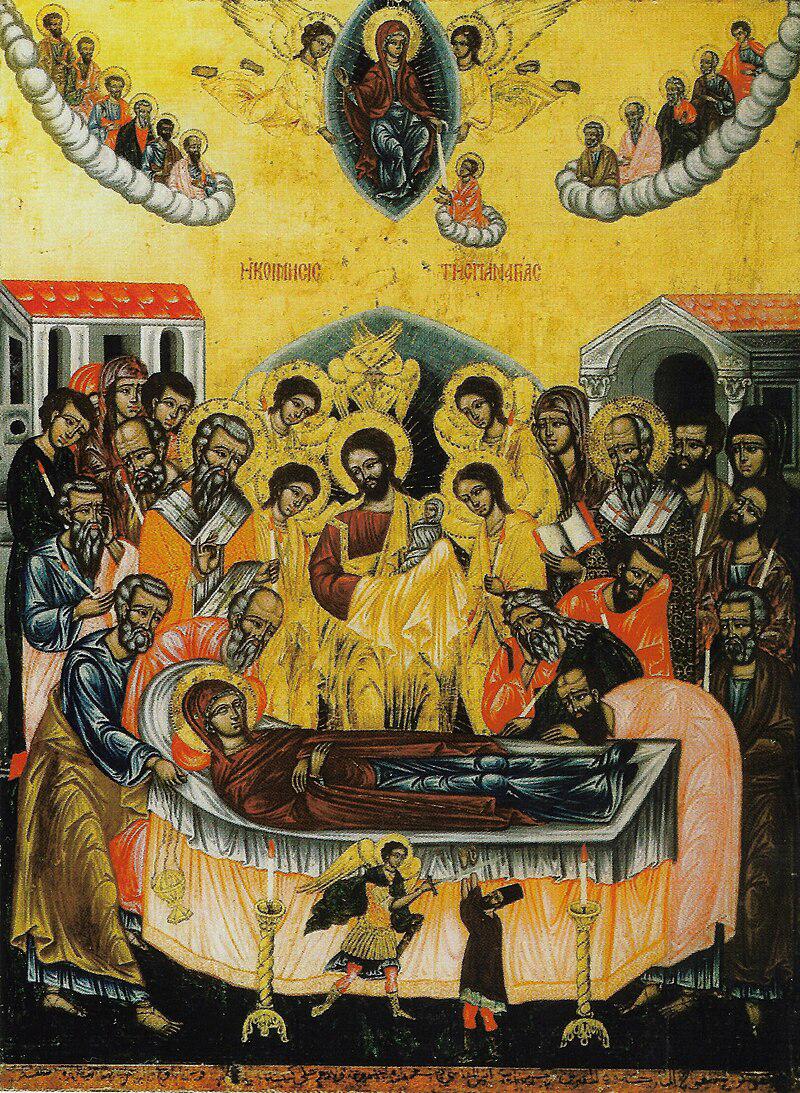
In the center of the icon, we see the Virgin Mary lying on a bed adorned with royal colors, surrounded by the Apostles.
The posture of her body is peaceful, and her face bears peace, not fear or distress. For the Church does not view her dormition as a tragic event, but as a passage filled with hope.
Her robe often appears in a dark purple or deep red color, pointing to her royal dignity and her participation in the mystery of the Incarnation. For she is not only the mother of a man, but she is the Mother of God (Theotokos), because He whom she bore is the Eternal Son, the incarnate Word of God.
The halo around her head proclaims her holiness and glory, while her placement in the center of the icon serves as a reminder that she was the center of the Church’s love and honor, for she bore Christ and gave Him to the world.
Second: Christ in the Midst of Glory Holding the Soul of His Mother
The most important element in the icon is the appearance of the Lord Jesus Christ above the body of His Mother.
We see Christ standing in His divine glory, surrounded by a golden halo or a mandorla, holding in His hands the soul of the Theotokos, depicted as a small child wrapped in white.
This scene carries a profound theological meaning: she who held Christ in her arms when He was an infant in Bethlehem is now seen being carried in the arms of her Son.
The Mother held her Son in the flesh, and now the Son holds the soul of His Mother. This proclaims that Christ is not only Mary’s Son according to the flesh, but is also the Lord of life and death.
For man is not overcome by death when united with Christ, because Christ entered death and conquered it by His Resurrection.
Third: The Bier of the Virgin and the Church Present Around Her
The bier upon which the Virgin reposes is not merely a place of rest, but a reminder of the tomb that could not hold her.
Just as Christ emerged from the tomb through the Resurrection, so the Theotokos became a sign of hope for all believers that death is not the end.
Around the bed, we see the Apostles gathered, representing the entire Church coming to bid farewell to her Mother.
Fourth: The Apostles in the Icon of the Dormition
According to Church Tradition, the Apostles had spread throughout the world to preach the Gospel. As the time of the Virgin's dormition drew near, God sent His angels, and the Apostles were miraculously gathered from where they were scattered throughout the world to take part in her farewell.
Therefore, some icons depict the Apostles being carried upon clouds, for they did not arrive by natural means, but through divine providence.
This recalls what occurred at the Ascension of Christ, where clouds in Holy Scripture are always associated with God's presence and glory.
The presence of the Apostles around the bier of the Theotokos is considered one of the most important elements of the icon. Those who carried the good news of Christ to the world gathered around Christ's Mother at this moment. This carries a deep spiritual meaning: the Church that was established and began on the Day of Pentecost with the Apostles now stands around the Theotokos, for she is the Mother of the Church and the Mother of all believers.
Saint Peter
Saint Peter appears bowing before the bed, holding a censer. He stands before the mystery of the Theotokos with reverence and honor.
The censer symbolizes prayer and veneration, as well as signifying that the Virgin's life was a sacrifice of prayer and praise to God.
Saint Paul
We also see Saint Paul bowing before the Virgin. The presence of Paul is very significant, for he was not among the Twelve who lived with Christ before the Crucifixion, but he became the Apostle to the Gentiles. This proclaims that the Virgin is not only the Mother of the Apostles who knew Christ on earth, but the Mother of the whole Church, both Jews and Gentiles.
The Rest of the Apostles
We see the other Apostles bearing various expressions:
• Some raise their hands in prayer.
• Some bow in veneration.
• Some hold books or scrolls pointing to the preaching of the Gospel.
The posture of the Apostles expresses the gathering of earth and heaven around this mystery. For those who preached the Resurrection of Christ are themselves now witnessing that the hope of resurrection encompasses all humanity.
Fifth: The Priests and Bishops Present in the Icon
In some models of the Icon of the Dormition, not only the Apostles appear, but also members of the clergy: bishops and priests.
These are not among the Apostles historically present according to Tradition, but they represent the Church that came after the Apostles.
They are often depicted in their priestly vestments, proclaiming that the whole Church, from the Apostles to the bishops, priests, and faithful, participates in honoring the Theotokos. Among the names mentioned by Tradition in certain texts are:
• Saint James, the Brother of the Lord, first Bishop of Jerusalem.
• Saint Dionysius the Areopagite.
• Saint Timothy, disciple of the Apostle Paul.
However, it should be noted that the presence of these figures varies from one icon to another, and not every model includes them all.
The purpose of their presence is not to provide an exact historical list of attendees, but to proclaim the unity of the entire Church around the mystery of the Theotokos.
Sixth: The Angels and Heavenly Glory
At the top of the icon, we see angels surrounding Christ. Their presence proclaims that all of heaven participates in this event.
For what took place was not merely the falling asleep of a holy person, but the entrance of the Theotokos into the glory that God prepared for mankind.
The golden color pervading the icon does not represent an earthly color, but symbolizes the light of the divine Kingdom.
In Orthodox icons, gold signifies the presence of God and the light of eternity.
Seventh: The Man Who Attempted to Touch the Bier
In some icons of the Dormition, a person appears extending his hands toward the bed of the Virgin, and an angel cuts off his hands with a sword. This person is named "Jephonias" in Tradition.
According to traditional accounts: he was a Jewish man who saw the funeral procession of the Virgin and attempted to touch the bier with disrespect, whereupon an angel appeared and struck him. However, when he repented and prayed, his hands were restored to him.
The spiritual meaning of this scene:
The icon does not aim to depict violence, but seeks to teach us that:
• The mysteries of God are not to be approached lightly.
• Honoring the saints must be done with faith and piety.
• Whosoever approaches God in humility finds mercy.
Eighth: The Candle and the Light
In some icons of the Dormition, a candle appears before the bed.
The candle symbolizes:
• Christ, who is the Light of the world.
• That death cannot extinguish the light of divine life.
• That the believer passes from this world into the light of the Kingdom.
Ninth: The Meaning of the Dormition in Orthodox Faith
The Church proclaims in the hymn of the Feast: "In giving birth you preserved your virginity, and in your dormition you did not forsake the world, O Theotokos. You were translated unto life, since you are the Mother of Life, and by your intercessions you deliver our souls from death."
For the Church believes that the Virgin's life did not end, but that she passed into new life with her Son. Her dormition is a foretaste of what awaits every person who believes in Christ.
Tenth: The Spiritual Message of the Icon
The Icon of the Dormition teaches us:
• That death is not the end, but a passage to Christ.
• That the human being who lives with God does not live in fear.
• That Christ, who held the soul of His Mother, is able to carry every person into the Kingdom.
• That the Resurrection is the goal of all creation.
For she who bore Christ into the world was carried by Christ into the embrace of the Kingdom. Therefore, the Church stands before the Icon of the Dormition not in sorrow, but in hope, seeing in it God's promise to every believer: "If anyone keeps My word he shall never see death" (John 8:51).