Sunday Divine Liturgy Homily
Sermon by Father Ramy Wannous - Sunday before Holy Cross - September 13, 2026
2026-09-16
In the name of the Father, the Son, and the Holy Spirit, One God, Amen.
Those who are committed to the prayers and services of the Church notice that when we have a specific feast, an important feast for Christ, we have the Sunday before this feast, the feast itself, and the Sunday after the feast. For example, the Sunday before Nativity, Nativity, and the Sunday after Nativity. The Sunday before the Transfiguration, the Feast of the Transfiguration, and the Sunday after the Transfiguration. The same applies to the Divine Manifestation (Epiphany).
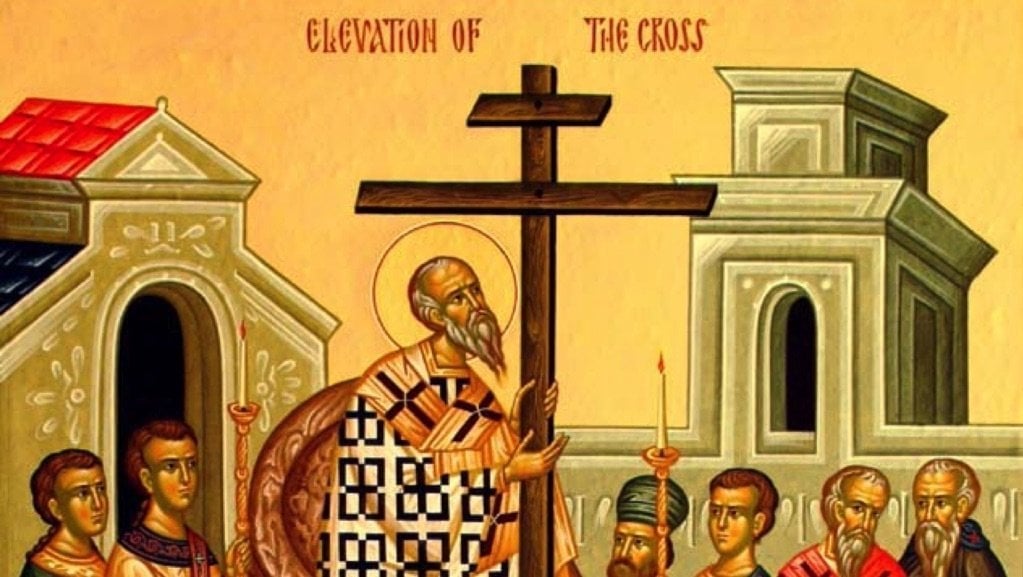
But the paradox is that if one focuses a bit, they will notice that the exact same thing happens regarding the Cross. Today, we have the Sunday before the Feast of the Exaltation of the Cross, we have the Feast, and next Sunday is the Sunday after the Exaltation of the Cross. This confirms, beloved, how deeply the Cross is connected to the Crucified. We cannot absolutely separate the Cross from the Crucified. It is as if the Church today is telling us that this feast consists of three parts. Or for those who like reading, it’s like having a series of three books; the first part tells you something, the second part tells you something else, and the third part concludes the story. So, what does the Church want to tell us today, on the Sunday before the Exaltation of the Cross, and what is the message it wants to convey through these three stations it has set for us?
Today, if we pay attention, it is telling us that "as Moses lifted up the serpent in the wilderness, even so must the Son of Man be lifted up." It is telling us what will happen to Christ: He will be crucified; He will be lifted up. Tomorrow, on the feast day, we will read about the incident of the crucifixion. Next Sunday, we will read, "Whoever desires to come after Me, let him deny himself, and take up his cross, and follow Me." This means the Church has informed you, you have seen, and afterward, you must decide. This is the general outline present in these three stations set by the Church today.
The Cross for us, as I mentioned, is closely attached to the Crucified. That is why, at the conclusion of every prayer, we always mention "and by the power of the holy and life-giving Cross." At the end of every prayer—pay attention to it today at the dismissal of the liturgy if anyone hasn't noticed it yet.
And if we want to talk a little about ecclesiastical art connected to theology—because ecclesiastical art is inherently an expression of theology. In reality, architecturally, whenever every church places the Cross (like the one above us here), this Cross must be like a tree under which a person seeks shade so they can feel what? If it is hot and someone sits under a tree, what do they feel? A cool breeze; their heart is refreshed, they feel rested. In ecclesiastical art, this tree (which is why we also call it the Tree of the Cross) is what shades the Holy Table (Altar). So when the sun strikes, the shadow falls on the Altar, and from the Altar, what do we feel? Comfort; our hearts are refreshed. This exists in ecclesiastical science and art, beloved.
This is intentional, so the Church can tell us that we should rejoice and find rest in the Cross. Thus, the Cross is no longer—see how it was transformed from an instrument of murder and execution into an instrument of salvation. Under the tree of the Cross, we seek shade, rejoice, and find rest. Consequently, we look at the Cross and adore it because we do not separate it at all from the Crucified.
And if we want a little help from the Church to know how we should think, the Apostle Paul comes to us today. The Church tells you: listen to what the Apostle Paul says today. Now, if I ask any of you, or perhaps if one of you asked me, we might all give a similar answer: What do you boast about? What do you take pride in? One might say, "I boast about my children, I boast about my education, my company, my money, my beauty." But the Apostle Paul is teaching us today how to change our way of thinking. Because when someone wants to boast, they boast about something they have done—this is human logic. What are you proud of? You talk about an achievement you made.
But this is not the mind of the Church. The Apostle Paul is wonderful; Paul tells you: "I do not boast about something I did, I boast about what Christ did for me!" And this is unprecedented in the history of humanity. It is unheard of for someone to boast about an act someone else did for them. Not just for Paul, but for every single one of us. That is why he said, "God forbid that I should boast except in the cross of our Lord Jesus Christ." Paul changes the logic of the world.
But why is Paul saying these words? Why is he saying "God forbid that I should boast"? For clarification, the word "God forbid" in the original Greek means absolutely not, under no circumstances, nothing else! Meaning, this word represents a life stance, a life decision, that I have nothing to boast about except what our Lord did for me, except the Cross of our Lord Jesus Christ. Why? Because he understood that everything a person does and boasts about just perishes and passes away; it is worthless. Worthless! That is why the Apostle Paul also says elsewhere: "I count all things as rubbish"—garbage! Garbage before Christ. Everything, absolutely everything, is nothing; nothing has meaning compared to Jesus Christ, compared to the Cross of Jesus Christ.
The Cross, then, beloved, as the Apostle Paul teaches us here, is our salvation, because it is what opened the door between us and Heaven. It is the vehicle, the rocket that took us up to the Kingdom; there is no other. That is why we boast about what the Lord did on the Cross. He showed us that love is the way and there is no other way, and He showed us that boasting is humility before this way, before this Cross. We have nothing else, beloved, to take pride in; it is our path to God. Because Christ told us: "Come here, I will die for you, I will die for your sake, and you will become My siblings." My siblings—and this is the door to the Kingdom. All you have to do is take this key and open the door, it is nothing more than that. And this key is the Cross.
That is why, if you have ever noticed—and for those who know the key to the ancient church of Mar Shaya—have you ever noticed that ancient keys are shaped like a cross? Have you noticed? It is the same thing, the key to the Kingdom is a cross, beloved. And this Cross, the Apostle Paul told us how we must boast in it and in it alone.
Therefore, beloved, when we stand before God, we will have nothing greater to say than: "O Lord, I am here because of the Cross of Your Son." Let it be, beloved, let this Cross be our boast, and let us say with Paul from the depths of our hearts: "God forbid that I should boast except in the cross of our Lord Jesus Christ." Amen.